

The evolution of medical diagnostics has revolutionized the methods of detecting and monitoring diseases within the laboratory setting. Particularly, the advancements in molecular testing methods have enhanced the accuracy of detecting diseases.
This has been particularly beneficial in the detection of sexually transmitted diseases, such as HPV, to ensure effective treatment and prevention.
HPV is ranked among the most common viral infections globally, and it has been linked to several health conditions.
On the other hand, the prevalence of STIs has been a concern for many healthcare facilities. Consequently, there has been an increased use of advanced methods such as molecular HPV testing kits and molecular diagnostic kits to enhance diagnostic procedures.
By using molecular HPV testing, diagnostic facilities can enhance their services, thus improving public health. This blog discusses the need for diagnostic facilities to adopt molecular HPV and sti testing kits, considering their role in shaping the future of diagnostic testing.
Growing Need for Accurate HPV and STI Detection
Sexually transmitted infections have always been of concern to global health. Many STIs, including HPV infections, may not manifest with symptoms in the initial stages of infection.
This means that people may transmit infections without even being aware of it. Therefore, it is crucial to detect STIs at an early stage for better control and prevention of STIs.
Traditionally used methods for STI detection have always been successful; however, at times it is difficult for these methods to detect infections at low levels. This is where molecular diagnostic kits offer a huge advantage in STI detection.
Molecular methods of STI detection help in analyzing the pathogen’s genetic material and assist in its identification with more precision.
By using molecular hpv testing kits, it is easier for laboratories to identify infections in people at the early stage of infection. This is where HPV STI detection kits for labs come in handy.
Understanding Molecular Diagnostic Testing
In order to understand the benefits of molecular HPV and STI testing, it is first necessary to understand what molecular diagnostic kits are and how they function.
Molecular diagnostic kits are meant to identify specific genetic sequences in a virus or a bacterium. This is unlike conventional methods of detection, which are based on symptoms and antibody production by the body in response to a virus or a bacterium.
The advantages of molecular diagnostic kits are:
- Highly sensitive to infections
- Accurate detection of specific infections
- Early detection of infections before symptoms appear
- Elimination of false-positive results
Since molecular diagnostic kits are capable of detecting infections at a very early stage, laboratories are increasingly using molecular testing for HPV in their diagnostic processes.
Advantages of Molecular HPV Testing Kits
The incorporation of molecular hpv testing kits has enhanced the ability to detect and identify HPV infections in clinical and laboratory settings.
Molecular HPV testing kits help in identifying high-risk strains of the virus that are linked to cancer development.
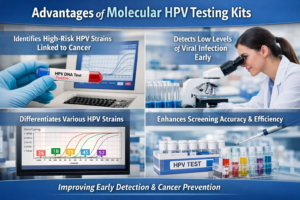
One of the key benefits of molecular HPV testing is that it is able to detect even low levels of viral infection. Early detection is a key aspect of preventing and controlling disease progression and patient outcomes.
Another key aspect of molecular hpv testing is that it is able to differentiate between various strains of the virus. Certain strains of the virus are linked to a higher propensity to develop cancer, and this helps in taking necessary precautions to prevent it.
The incorporation of molecular HPV testing kits is a key aspect of making a screening program more efficient and reliable.
Improving STI Detection in Laboratories
Besides HPV, molecular technology has the potential to revolutionize the diagnosis of many sexually transmitted infections.
Generally, sexually transmitted infections can co-exist or manifest with similar clinical presentations, and therefore, their accurate diagnosis is critical.
HPV STI detection kits for use in the laboratory allow the diagnosis of multiple sexually transmitted infections simultaneously, thus enabling the laboratory to diagnose several infections with the use of one single test.
The advantages of the use of HPV STI detection kits for use in the laboratory include:
- The ability to obtain results quickly
- Ability to screen patients for many infections
- Elimination of the need to conduct many tests
- The ability to enhance the efficiency of laboratory operations
The use of molecular diagnostic kits has the potential to enable the accurate and timely diagnosis of sexually transmitted infections in the laboratory.
Enhancing Laboratory Efficiency and Workflow
Another key reason why laboratories are using molecular diagnostic kits is that it helps in improving efficiency in laboratory work.
Molecular testing technologies used in modern laboratories tend to be automated and can handle high sample throughput. This enables laboratories to test multiple samples at once without compromising accuracy.
By using molecular testing for hpv infections in laboratories, it is easier to simplify laboratory tests and reduce the period of time before test results can be obtained. This enables clinicians to treat patients in a timely manner.
It is also easier to prevent human error in laboratories through automated systems used in hpv sti detection kits for labs.
Advancing Public Health Through Molecular Testing
- In addition to providing individual patients with the benefits of the molecular HPV testing kits, the adoption of such testing kits plays a critical role in enhancing the success of public health initiatives.
- Screening programs for the detection of hpv and other stis are greatly dependent on the testing kits used for such programs.
- Laboratories using advanced molecular diagnostic kits for disease surveillance and prevention are more likely to contribute to more accurate disease surveillance and prevention programs.
- Early detection of stis enables healthcare practitioners to provide timely treatment for patients, thereby reducing the prevalence and incidence of stis.
This is critical for hpv screening programs targeting the early detection and prevention of cervical and other hpv-related cancers. Incorporating hpv testing using molecular testing kits is critical for national and global health initiatives targeting the reduction and control of stis.
Future of Molecular HPV and STI Testing
As medical science evolves further, molecular diagnostics are likely to play an even bigger role in the detection and management of diseases.
This is because scientists are continually working to improve diagnostic tests, such as developing faster, more sensitive, and cheaper diagnostic methods. The future of diagnostic methods may involve the development of diagnostic platforms capable of simultaneously detecting multiple diseases while ensuring quick results.
This would further improve the efficiency of molecular diagnostics for hpv and other infectious diseases. Moreover, developments in digital health systems are likely to improve the role of molecular HPV testing kits.
For labs looking to stay at the cutting edge of modern diagnostics, the use of advanced molecular diagnostic methods would be critical in the future.
Final Thoughts
The increased rate of HPV and other sexually transmitted diseases has emphasized the importance of developing accurate, efficient, and reliable diagnostic solutions.
Molecular diagnostic solutions have emerged as one of the most effective solutions in this regard. By using HPV STI detection kits, diagnostic centers can enhance their efficiency in detecting infections with more accuracy.
The use of molecular diagnostic kits has enabled laboratories to detect infections using genetic materials. Using molecular HPV testing kits and molecular testing solutions can also benefit public health initiatives and programs.
As innovation continues to advance and develop more effective diagnostic solutions, organizations such as Uncoded are contributing to the development of new and effective solutions in the field of healthcare research and technology-driven solutions.