Myeloid Profiler RNA Panel

Understand the Role of RNA in Myeloid Cancers
Myeloid malignancies, such as acute myeloid leukemia (AML) and myelodysplastic syndromes (MDS)—often stem from complex genetic changes, particularly gene fusions and chromosomal translocations. These alterations are critical biomarkers in diagnosis and treatment decisions, making RNA sequencing for myeloid malignancies an essential tool for modern research and clinical applications, including the use of a myeloid molecular panel.
RNA-based gene panel testing enables deeper molecular insights by:
- Detecting fusion transcripts that DNA panels may miss
- Supporting targeted therapies and personalized treatment strategies
-
Aiding in early diagnosis and subtype classification, similar to an acute myelogenous leukemia panel kit

Overcoming Detection Challenges with the Myeloid Profiler RNA Panel
Detecting fusion genes in myeloid cancers is complex due to:
- Low expression levels
- High genetic heterogeneity
- Presence of rare or novel fusion events
The Myeloid Profiler RNA Panel, an advanced NGS myeloid gene panel addresses these challenges with:
- Detection of 52+ key fusion genes and 600+ fusion variants
- High sensitivity and specificity through optimized RNA capture technology
- Compatibility with degraded or low-quality RNA samples

Product Overview: Next-Generation Fusion Gene Profiling
The Myeloid Profiler RNA Panel is a next-generation sequencing (NGS) assay engineered for comprehensive RNA fusion detection in myeloid malignancies, functioning similarly to an acute myelogenous leukemia panel kit.
Key Features:
- Extensive Fusion Coverage: Identifies both known and novel gene fusions
- Streamlined NGS Workflow: Designed for efficiency and reduced turnaround time
- High Accuracy & Reproducibility: Enables confident clinical and research decision-making
- Versatile Applications: Suitable for translational research, clinical diagnostics, and precision oncology studies

Applications of Myeloid Profiler RNA Panel
| Cat. No. | Reactions |
|---|---|
| UNONC/0508/024 | 24 |
| UNONC/0508/048 | 48 |
| UNONC/0508/096 | 96 |
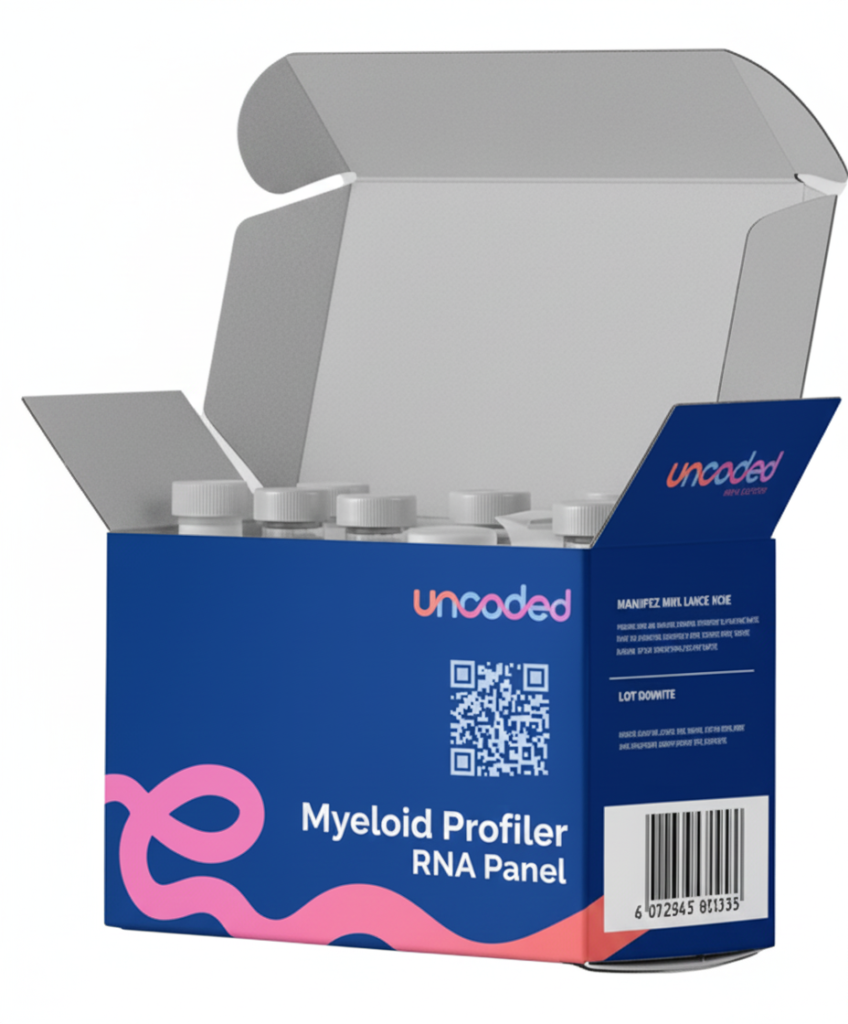
| Store at -20°C to -15°C for long-term stability. |
| Avoid repeated freeze-thaw cycles to maintain assay performance. |

Frequently Asked Questions
Curious about workflow, accuracy, or compatibility? Find all your answers here
The Uncoded Myeloid RNA Panel is designed to comprehensively detect gene fusions that are critical in the development and progression of myeloid malignancies. It targets 52 known fusion genes and can identify over 600 fusion variants, ensuring detection of both common and rare fusion events. These include clinically significant fusions such as RUNX1T1, CBFB, MYH11, BCR, ABL1, and many others. This detailed profiling aids in precision research and the development of personalized treatment strategies.
The panel requires up to 100 ng of total RNA, making it suitable for studies where sample material is limited. This low input requirement ensures flexibility in handling precious clinical research samples without compromising data quality or sensitivity.
The panel is validated for use with blood and bone marrow samples, which are the most relevant sample types for myeloid malignancy research. These matrices provide reliable RNA for high-quality sequencing results.
This panel offers high analytical sensitivity, capable of detecting fusion events with a Variant Allele Frequency (VAF) as low as 2%. This makes it highly effective in identifying clinically significant fusions, even in heterogeneous tumor samples.
The Uncoded Myeloid RNA Panel ensures robust performance metrics:
- >95% target regions covered at ≥1000× depth for high confidence detection.
- On-target rate of >85%, which maximizes sequencing efficiency and cost-effectiveness.
Fold 80 <1.4, ensuring uniform coverage across targets for reliable analysis.
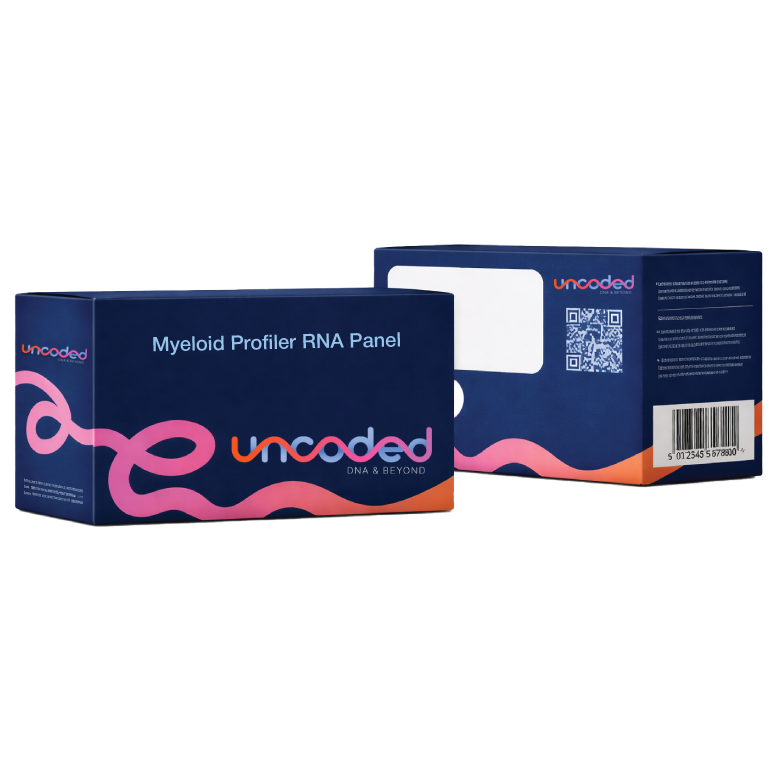
The Myeloid RNA Panel is available in three scalable formats to suit different research needs:
- 24 reactions (Cat. No. UNONC/0508/024)
- 48 reactions (Cat. No. UNONC/0508/048)
96 reactions (Cat. No. UNONC/0508/096)
This flexibility ensures cost efficiency for small-scale studies as well as large research projects
The Uncoded Myeloid RNA Panel features a streamlined hybrid-capture workflow that minimizes hands-on time and complexity compared to many amplicon-based or multi-step competitor panels. With integrated library prep, efficient target enrichment, and minimal PCR cycles, the process is optimized for faster turnaround without compromising sensitivity or coverage
What are the challenges of 16S V3-V4?
How does16S V3-V4 improve compliance?
Lorem ipsum dolor sit amet consectetur. Dolor aenean lorem integer nunc at nascetur enim. At porta eu imperdiet porta condimentum vitae in lacus. Amet placerat senectus justo integer nulla lobortis bibendum sed quam. Morbi consequat iaculis et est elementum in.
What is 16S V3-V4?
Lorem ipsum dolor sit amet consectetur. Dolor aenean lorem integer nunc at nascetur enim. At porta eu imperdiet porta condimentum vitae in lacus. Amet placerat senectus justo integer nulla lobortis bibendum sed quam. Morbi consequat iaculis et est elementum in.
How does16S V3-V4 improve compliance?
Lorem ipsum dolor sit amet consectetur. Dolor aenean lorem integer nunc at nascetur enim. At porta eu imperdiet porta condimentum vitae in lacus. Amet placerat senectus justo integer nulla lobortis bibendum sed quam. Morbi consequat iaculis et est elementum in.