
Vision problems usually progress gradually. However, not all vision problems are as silent and dangerous as glaucoma.
In fact, many people are unaware of the presence of the problem until some damage to the vision is done. Therefore, it is extremely important for a person to know what is meant by glaucoma, the symptoms of the problem, and the ways to detect the problem before it is too late.
Glaucoma is one of the leading causes of irreversible blindness in the world. The alarming factor is that in the early stages of the problem, it is completely painless and causes minimal symptoms.
However, it is definitely possible to detect the problem in the early stage with the help of proper awareness and modern technology.
What Is Meant by Glaucoma?
To understand early signs of glaucoma, it is important to understand the term glaucoma.
Glaucoma is actually a cluster of eye conditions that affect the optic nerve. The optic nerve is responsible for sending messages to the brain from the eye. When this happens, vision loss occurs. The loss of vision is usually peripheral.
In most cases of glaucoma, increased pressure within the eye is responsible. However, it is important to note that glaucoma can also occur even when eye pressure is normal.
There are many types of glaucoma, but the two most common types are:
- Open-angle glaucoma: It is usually slow to develop and symptomless.
- Angle-closure glaucoma: It is usually sudden and is a medical emergency.
The most common type of glaucoma is open-angle glaucoma. It is for this reason that eye examinations are important.
Why Early Detection of Glaucoma Is Critical
The loss of vision due to glaucoma is permanent. The optic nerve fiber’s that are damaged by glaucoma cannot be repaired.
However, it is important to note that when glaucoma is diagnosed early enough, it is possible to slow down its progress considerably.
This is why it is important to learn how to detect glaucoma before vision loss is noticeable. It is important to note that when glaucoma is diagnosed early enough, it is possible to:
- Monitor eye pressure
- Prescribe medicated eye drops
- Recommend laser therapy
- Prevent further optic nerve damage
The earlier glaucoma is diagnosed, the better the chances of having healthy vision.
Must Know the Early Signs of Glaucoma
One of the most common queries that people ask is: what are the early signs of glaucoma?
The difficulty is that when open-angle glaucoma is in its early stages, there are no noticeable signs or symptoms. This is the reason why it is one of the most dangerous.
There are some early signs of glaucoma, though.
Gradual Loss of Peripheral Vision
The most common of the early signs of glaucoma is the gradual loss of peripheral vision. Many people do not realize this because their central vision remains unimpaired.
Some of the signs that you may experience include:
- Difficulty in seeing objects to the side
- Difficulty in driving, especially during the night
- Frequently bumping into objects
- Difficulty in navigating areas where the light is dim
Symptoms of Glaucoma in Eyes: Recognizing Warning Signals
Although open-angle glaucoma develops slowly, in the case of angle-closure glaucoma, there are noticeable symptoms.
The acute symptoms of glaucoma in eyes include:
- Severe eye pain
- Sudden blurred vision
- Redness in the eye
- Headache
- Nausea or vomiting
- Seeing halos around lights
These acute symptoms require immediate attention to prevent loss of vision.
How to Detect Glaucoma Before Vision Loss
Since there may be no symptoms at first, the best way to detect glaucoma is to undergo a comprehensive eye examination.
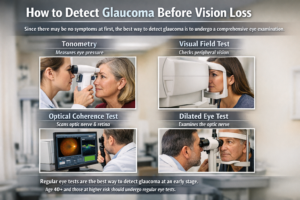
There are different tests that eye experts conduct to diagnose the early signs of glaucoma:
-
Tonometry
Tonometry measures the pressure inside the eye. Increased pressure can lead to glaucoma.
-
Visual Field Test
The Visual Field Test checks the peripheral vision and detects blind spots that may be associated with damaged optic nerves.
-
Optical Coherence Test
The Optical Coherence Test uses images taken by a special scanning device to check for damage to the optic nerve and retina. This can be detected even before there are symptoms.
-
Dilated Eye Test
In this test, an ophthalmologist checks the optic nerve for damage.
Regular eye tests are the best way to detect glaucoma at an early stage. Those aged 40 and above, and those who have increased risks, should undergo regular eye tests.
Who Is at Higher Risk of Developing Glaucoma?
Recognizing your risk factors is part of the process of learning how to spot glaucoma early.
You may be at increased risk if you:
- Are over 40 years old
- Have a family history of glaucoma
- Have diabetes or high blood pressure
- Experience high eye pressure
- Had eye injuries in the past
- Are of African, Asian, or Hispanic descent
If you have these risk factors, monitoring your health closely is even more important.
What are the early signs of glaucoma that people ignore?
Since the symptoms are not dramatic, it is easy to dismiss the changes that may be occurring.
The changes that may be occurring and that people may be ignoring include:
- Slightly having difficulty adjusting to the dark
- Experiencing slight eye discomfort
- Experiencing the gradual narrowing of the visual range
- Experiencing increased eye strain
These changes may be the first signs of optic nerve damage, and the only sure way to determine if it is not occurring is to have an eye exam.
The Role of Technology in Early Detection
Innovations in digital healthcare services and imaging technologies are significantly changing the detection of glaucoma.
Technology firms have played a vital role in facilitating the detection of glaucoma.
Uncoded specializes in creating intelligent digital technologies aimed at improving healthcare services like glaucoma panels. The company focuses on creating a software platform that can effectively handle medical imaging diagnostics.
With the evolution of healthcare technologies, the detection of glaucoma at early stages has been made easier. Modern healthcare technologies enable doctors to detect changes in the structure of the eye before they impair vision.
Can Glaucoma Be Prevented?
Although glaucoma cannot be prevented in all instances, early detection can prevent serious vision loss.
The steps to prevent glaucoma are as follows:
- Scheduling eye examinations
- Managing hypertension and diabetes
- Exercise
- Avoiding smoking
- Protecting eyes from injury
Living with early-stage glaucoma
Early-stage glaucoma can be managed successfully if detected early. The steps to manage glaucoma are as follows:
- Prescription eye drops
- Laser treatments
- Surgery in advanced stages
Most people with glaucoma can enjoy their lives with good vision if they follow their treatment regimens.
Final Thoughts
Glaucoma is a critical but asymptomatic eye condition that can result in complete blindness if not addressed.
It is, therefore, critical to understand the meaning of the term glaucoma, the symptoms of glaucoma, and the early signs of glaucoma that often go unnoticed.
The symptoms of glaucoma in the eye may be very minor or non existent, which is why regular eye checkup’s are the best answer to the question of how to detect glaucoma.
Today, with the advent of diagnostic technologies and digital health infrastructure powered by innovative technology companies like Uncoded, detecting glaucoma is becoming more precise.
It is, therefore, critical to understand that protecting your vision is not just about addressing the symptoms of glaucoma but also about becoming aware of the condition long before the symptoms of glaucoma develop.