

Precision oncology has revolutionized cancer detection, monitoring, and treatment in this rapidly changing field.
Genetic screening has conventionally focused on popular cancer susceptibility genes, such as BRCA1 and BRCA2, mainly for breast and ovarian cancers. Nevertheless, current advances in genomic technology enable broader and more informative testing through the hrr gene panel test strategies that extend far beyond simple BRCA screening.
These comprehensive panels assess critical genes in the homologous recombination repair pathway, giving further insight into tumor biology and targeted treatment strategies across many cancer varieties.
This article explores why HRR gene panels are an important component in the era of precision oncology, among other things, in tailored cancer care.
What is precision oncology?
Precision oncology is the term that defines the method in the fight against cancer. By using the particular characteristics of the patient’s genes and molecular makeup to better address the case.
One-size-fits-all therapies are replaced in precision oncology with the search for the patient based on particular biologic markers, DNA mutations, and cell behaviours present in the tumor.
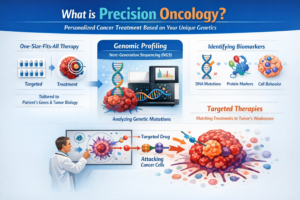
A key component of precision cancer medicine is the process of genomic profiling through the use of next-generation sequencing (NGS) and other cutting-edge tools to characterize the genetic signature of the tumor.
Through the use of actionable mutations, the physician can determine which targeted therapies to administer to the cancer cells based on their vulnerabilities.
From BRCA Testing to HRR Gene Panels: A Paradigm Shift
BRCA1 and BRCA2 gene tests were considered the gold standard for testing people at high inherited risk for both breast and ovarian cancers. BRCA1 and BRCA2 gene mutations impair DNA repair.
Although BRCA testing is still valuable, it is only part of the broader DNA repair mechanism referred to as homologous recombination repair (HRR).
Homologous recombination repair is a major cellular pathway that repairs double-stranded DNA breaks, a form of DNA damage known to be one of the most lethal types.
Inactivation of this pathway has serious cellular consequences, and it has often been implicated in cancer initiation and accumulation.
An hrr gene panel test looks at many of these genes at the same time rather than viewing one or two in particular. This offers greater improvement in the accuracy of diagnosis and identification by leveraging more information for providers and their patients.
What Is an HRR Gene Panel?
It is a multigene test that is intended for the detection of alterations in the homologous recombination repair pathway.
Next-generation sequencing (NGS)-based tests evaluate dozens of HRR genes for mutations, deletions, insertions, and other genomic alterations that could affect the efficiency of DNA repair.
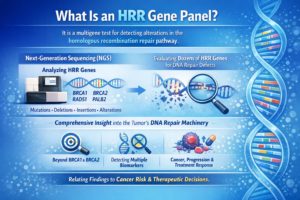
An HRR panel offers a comprehensive overview of a tumor’s DNA repair machinery. Moreover, it does not screen solely for BRCA1/2 but instead examines the functional authenticity of the entire HRR system.
This increases its sensitivity in detecting a multitude of possible biomarkers, which are then related to cancer, progression, and responses.
Advantages of HRR Gene Panels Over Traditional BRCA-Only Testing
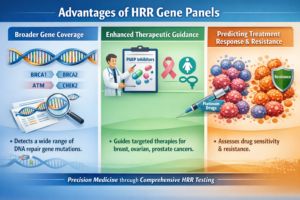
1. Broader Gene Coverage
BRCA testing involves analyzing two genes. By contrast, modern HRR panels examine a multitude of genes that work together to ensure DNA repair. Such panels include changes to other genes such as ATM, and more.
Owing to their broad-spectrum nature, HRR panels identify mutations, which otherwise escape detection during BRCA testing. This is particularly important in patients who lack BRCA mutations yet have impaired HRR.
2. Enhanced Therapeutic Guidance
One of the major advantages of hrr panel testing is that it has the capacity to guide directed therapy. In the event that the HRR repair pathway is defective in a tumor, it is likely to respond to PARP inhibitors. The PARP inhibitors are drugs that selectively kill tumor cells due to the deficiency of the HRR repair pathway.
Its effect is especially pronounced for types such as ovarian cancer and breast cancer, while there are increasing suggestions that it is also useful for other types of cancer, such as the hrr testing for prostate cancer if the HRR genes are altered.
3. Predicting Treatment Response and Resistance
On a broader note, besides discovering potential drug targets, HRR panels are also useful in determining a tumor’s sensitivity to a drug or possible resistance to it. For instance, a tumor with an impairment in HRR may be rendered more susceptible to platinum-based drugs.
This is due to the drug’s ability to induce damage to tumor cells, which are difficult to repair in cells lacking high repair capabilities. On a different note, mutation status may also imply drug resistance.
In doing so, HRR gene panel testing promotes a tenet of precision medicine: the provision of dynamic, evidence-driven treatment.
HRR Testing in Prostate Cancer: Why It Matters
Though BRCA mutations are primarily recognized in relation to cancers of the breast and ovaries, HRR gene modifications are also an important consideration in cases of prostate cancer, especially when it is an advanced condition.
Research has indicated that no less than one in four cases of metastatic castration-resistant prostate cancer contains alterations in HRR genes. Detection of such modifications via hrr testing for prostate cancer is helpful in determining follow-on therapy with PARP inhibitors.
HRR gene panel testing as a guideline for many men with prostate cancer, including advanced and metastatic disease. This approach is beneficial, as it ensures that individuals with actionable mutations will receive targeted therapies and not generic chemotherapy.
To Wrap up
This transition from single-gene tests such as BRCA to hrr gene panel test approaches is a milestone development within precision oncology.
Here, the enhanced comprehension of DNA repair mechanisms offered through homologous recombination repair (HRR) gene analysis enables healthcare providers to gain valuable insights that help predict outcomes and personalize patient care.
Whether in the evaluation of hereditary cancer risk, PARP inhibitor treatment, or other cancers like prostate, breast, and ovarian, among many, HRR testing is the embodiment of the future of genomic medicine.
With advancements in technology and the deluge of data set to continue, HRR panel testing is expected to continue its guidance in the future of personalized cancer treatment for patients.