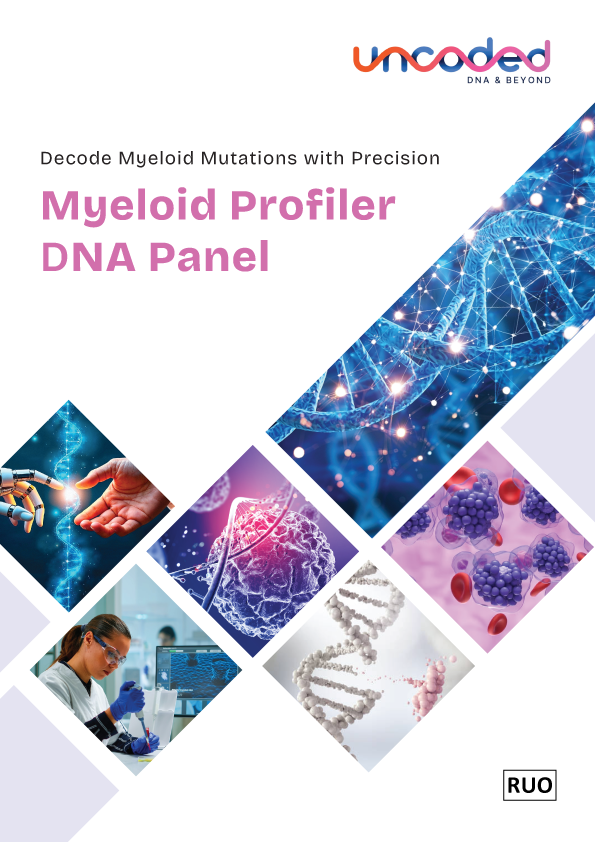
Myeloid Profiler DNA Panel
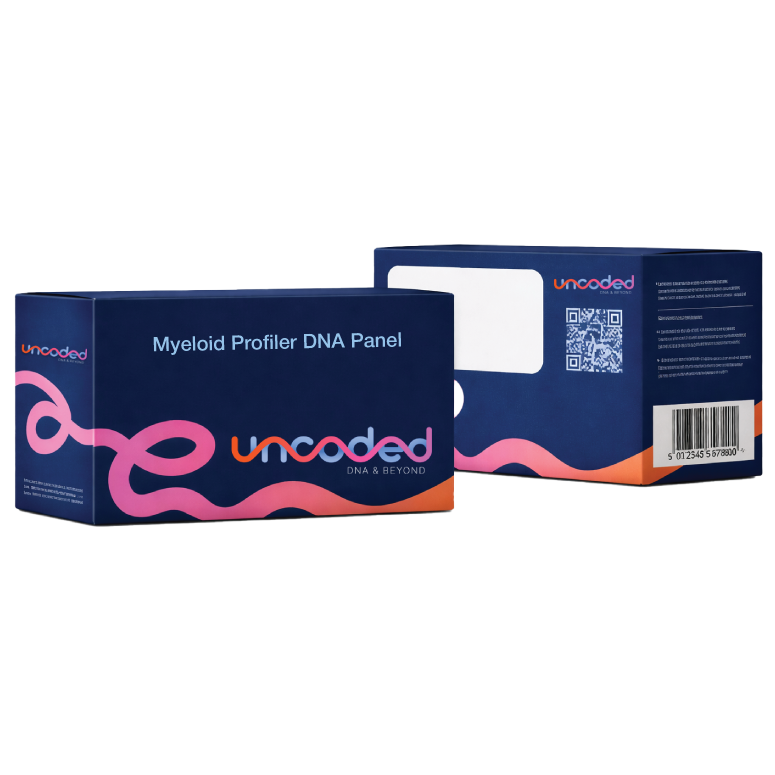

Precision DNA Profiling for Myeloid Malignancies
Acute myeloid leukemia (AML), myelodysplastic syndromes (MDS), and myeloproliferative neoplasms (MPN) are among the myeloid malignancies with an exceptionally complex and diverse genetic landscape. A wide range of genetic changes underlie many illnesses, affecting diagnosis, prognosis, and treatment choices. To face these diagnostic and therapeutic complexities, researchers and clinicians need a next-generation sequencing (NGS) for cancer platform that leaves no crucial variant undiscovered. The Uncoded Myeloid Profiler DNA Panel, a comprehensive myeloid mutation panel, meets this demand by providing a thorough and high-resolution method for genetic testing for cancer, allowing both researchers and clinicians to gain crucial insights into the entire range of myeloid cancers.

Why Is It Important to Analyze Myeloid Mutations?
Myeloid cancers are not caused by a single genetic event, they are driven by accumulations of mutations across many genes involved in cell signaling, DNA repair, apoptosis, and differentiation. This diversity of genetic lesions leads to highly variable clinical presentations and outcomes. The use of a myeloid malignancies mutation panel enhances the ability to detect these variations with precision.
- Precision in Diagnosis: Mutations in genes such as NPM1, FLT3, RUNX1, and ASXL1 drive not only initial disease classification, but also ongoing risk stratification and response prediction.
- Prognostic Value: Many myeloid gene mutations serve as markers for prognosis; for example, TP53 or RUNX1 mutations are associated with poor outcomes, while others impact therapy selection.
- Therapeutic Targets: Certain mutations (FLT3, IDH1/2, JAK2) are directly actionable with targeted therapies, facilitating precision medicine in oncology.

Major Challenges in Comprehensive Myeloid Profiling
Comprehensive profiling of myeloid conditions faces several significant challenges. The inherent variability and occurrence of overlapping or concurrent mutations necessitate a broad and inclusive approach to profiling. Identifying rare variants, typically found at low allele frequencies—requires high sensitivity, especially for early detection and monitoring of minimal residual disease (MRD). Furthermore, variations in specimens present another challenge, as the tumour content can differ greatly between bone marrow and peripheral blood, highlighting the need for reliable and efficient chemistry. Finally, the intricate nature of result interpretation demands sophisticated bioinformatics in cancer research to guarantee correct variant annotation and efficient clinical reporting. This is why advanced solutions such as a myeloid next generation sequencing panel are essential.

Applications for Myeloid Profiler DNA Panel
Initial Diagnosis
Comprehensive assessment of mutational status at presentation. This enables precise classification of myeloid malignancies, helping clinicians choose the most appropriate diagnostic category and initiate timely treatment plans.
Prognostic Assessment
Stratification by gene mutation profile to guide therapy. Specific mutations help predict disease course and treatment response, allowing doctors to tailor therapies according to risk. This profiling also aids in identifying patients who may benefit from more aggressive interventions or novel clinical trials.
MRD Monitoring
Sensitive detection of low-level variants post-therapy. Monitoring minimal residual disease helps detect relapse earlier than conventional methods, facilitating prompt adjustments in treatment. Accurate MRD tracking improves long-term patient outcomes by informing decisions about maintenance therapy or additional interventions.
Relapse and Transformation
Monitoring for clonal evolution or therapy-related mutations. Detecting new or emerging mutations during or after treatment aids in identifying disease progression or transformation to more aggressive forms. This information guides modifications in therapeutic strategies to address resistance or relapse.
Clinical Trials
Patient selection and stratification in precision medicine studies. Comprehensive genetic profiling using a Myeloid NGS Panel ensures accurate identification of eligible patients based on their mutational landscape, improving trial outcomes. It also helps in monitoring treatment responses and uncovering biomarkers for novel targeted therapies.
Academic & Translational Research
Longitudinal, population, and cohort-level studies. The panel supports in-depth analysis of mutation patterns over time across diverse populations, contributing to scientific understanding of disease mechanisms. It aids in identifying novel biomarkers and developing new therapeutic approaches through translational research.
| Cat. No. | Reactions |
|---|---|
| UNONC/0507/024 | 24 |
| UNONC/0507/048 | 48 |
| UNONC/0507/096 | 96 |
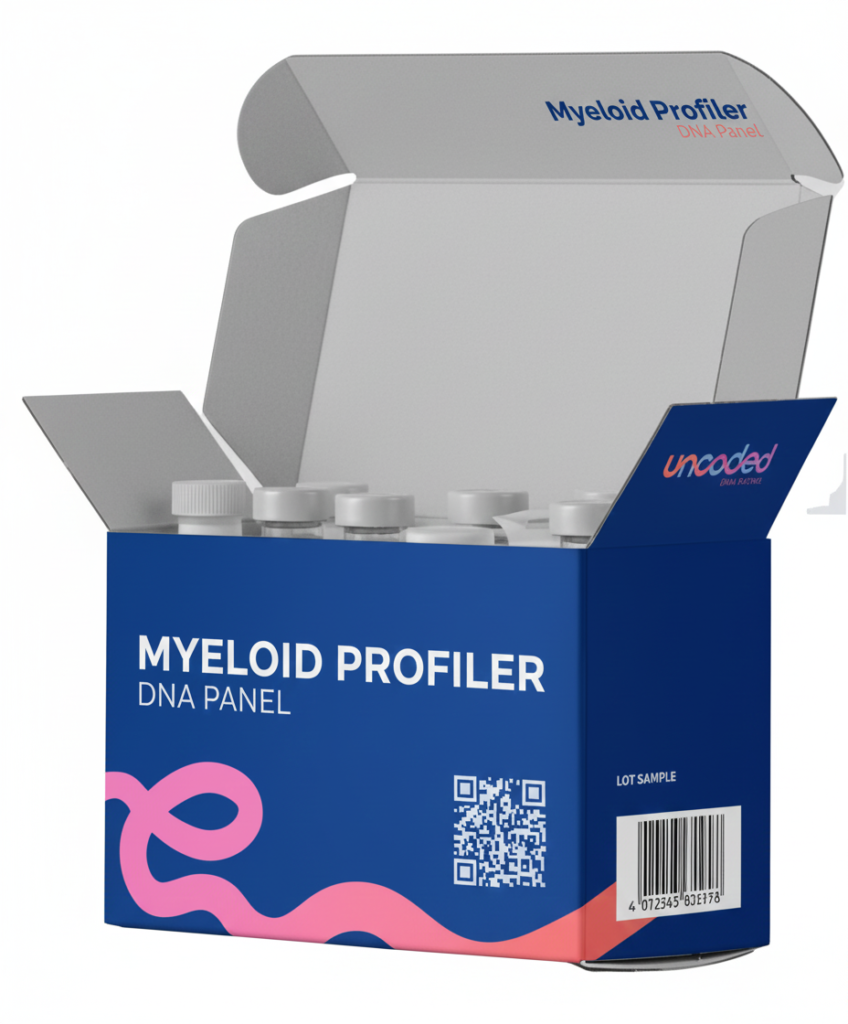
| Store at -20°C to -15°C for long-term stability. |
| Avoid repeated freeze-thaw cycles to maintain reagent integrity |

Frequently Asked Questions
Curious about workflow, accuracy, or compatibility? Find all your answers here
What are the challenges of 16S V3-V4?
How does16S V3-V4 improve compliance?
Lorem ipsum dolor sit amet consectetur. Dolor aenean lorem integer nunc at nascetur enim. At porta eu imperdiet porta condimentum vitae in lacus. Amet placerat senectus justo integer nulla lobortis bibendum sed quam. Morbi consequat iaculis et est elementum in.
What is 16S V3-V4?
Lorem ipsum dolor sit amet consectetur. Dolor aenean lorem integer nunc at nascetur enim. At porta eu imperdiet porta condimentum vitae in lacus. Amet placerat senectus justo integer nulla lobortis bibendum sed quam. Morbi consequat iaculis et est elementum in.
How does16S V3-V4 improve compliance?
Lorem ipsum dolor sit amet consectetur. Dolor aenean lorem integer nunc at nascetur enim. At porta eu imperdiet porta condimentum vitae in lacus. Amet placerat senectus justo integer nulla lobortis bibendum sed quam. Morbi consequat iaculis et est elementum in.